Fred Wilson, Marc Andreessen, and Stewart Butterfield (Slack Founder) recently opined on the importance of product market fit (PMF) and utilizing the seed round of financing to find it. However, finding product market fit is a massive challenge, even after you think you’ve found it. Ultimately, the ideal scenario is when the right product, meets the right market, at the right time, with the right team. This “perfect storm” is incredibly rare and oftentimes founders will make up for this missing serendipity by replacing it with hard work, outbound sales efforts, and pounding pavement.
The reality is that product market fit is found through rapid iteration and working intelligently to better understand the customer need, how the product most efficiently fits that need, and how to deliver value to the customer most effectively. As a seed stage investor that has made 20+ seed deals in the last 18 months, we typically make an investments with these underlying assumptions: there is a big and growing market, product seems to be great, some people are paying for the product and love it, a strong team is in place to develop more product and has the potential to win the market.
However, as soon as a seed round is raised, the clock begins ticking, and the company needs to set up to hit the benchmarks required to raise a Series A. The company needs to rapidly iterate through both market development and product development exercises in order to find, with some degree of certainty, a message and product that broadly resonates with customers and is set up for rapid scale. You’ll know when you’ve hit PMF – it’s when the company can no longer capitalize on demand with existing resources, time to raise your Series A.
The Framework
As part of the first kickoff sales meeting with our portfolio companies, I utilize a framework* that simply helps to focus on value proposition to drive early sales pitches and product focus. For example, Catalyze, one of our portfolio companies, had 3 products and sold into 2 different market segments (enterprises and start-ups) with several sub segments within each market segment. We used this framework to focus on the value proposition that would resonate across most customers and to help tailor the pitch to each segment depending upon their specific product needs. This simple framework has been an easy way to revisit and crystalize messaging based on the feedback that we’ve seen from current customers:
Travis Good, CEO of Catalyze.IO: “One of the major challenges we faced in scaling our revenue was to solidify the relevant aspects of our value to customers and distill those aspects down into something that was documented, measurable, iterative, and ultimately repeatable. Initially we documented everything in the framework on a whiteboard. We did this for each customer segment that we had. We then transferred this into a shared Google Doc and collaborated over time based on discussions with customers and prospects.
It was immensely valuable for us to take the time to systematically assess our products and market using the framework provided. The process, as well as the outcome of the process, has evolved but continues to be of use for us as we transition from stage, to Series A, and to preparing for Series B. Despite initiating this process early on, post our seed funding, I do feel that thinking through this framework earlier on would have been beneficial to use in testing some of our early hypotheses and accelerate our path to product market fit.”
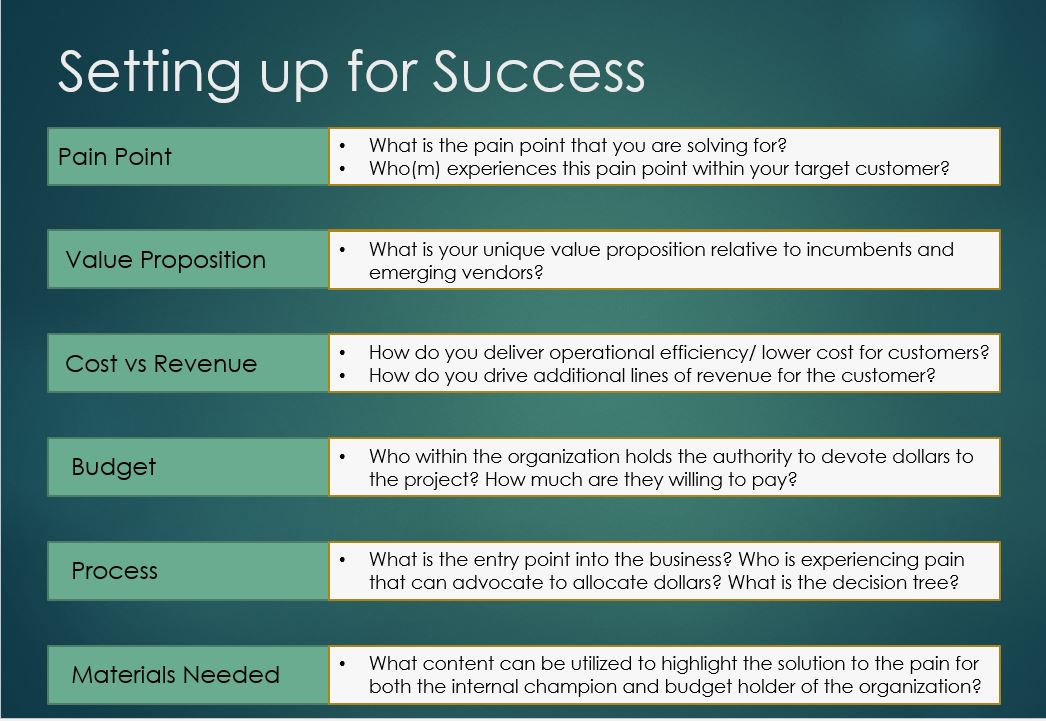
Pain Point
- Typically experienced by founder/management team from previous personal experience
- Is the problem difficult to solve with existing solutions or human capital in a cost effective manner? Does the customer know they have pain? How badly do they want to fix it?
- Methodically assess both qualitative and quantitative size and urgency of pain point
Value Proposition
- Develop one line pitch to describe 1) who the product helps, 2) how it solves the problem, and 3) how it is unique
- You have a solution to a customer’s problem, so what? Why should they buy your product?
Cost vs Revenue
- How does the product help customers to reduce spend across product development, time to market, human capital, or operational efficiency?
- How does the product help customers to create additional revenue by enhancing their existing product investments, differentiating from competition, or changing the delivery mechanism of their service/offering?
Budget/ Process
- Every sale is different but there are typically multiple players involved in an enterprise sales decision, who holds budget and who is the internal champion?
- What are the needs/goals of each player along the decision chain and how do you create messaging to address each?
- Map process and appropriate steps to involve the proper resources and employ corresponding messaging at each stage of the sales process
Content
- Create case studies, white papers, ROI calculators, customer interviews, and sales stage specific content to drive customers through each stage of the sales process
- Reward initial customers for taking the risk on a start-up, make them heroes, sing their praises
Competition
- Map out competitors across product areas/verticals
- How does your company compete from a product, process, messaging standpoint?
- How do you prove it with content/customer references?
- What is your unfair competitive advantage and how do you defend it?
This exercise is meant to provide clarity as founders too often get lost in the weeds and fail to deliver a simple message that resonates with prospective customers, why did our customers buy in the first place and how do they get value out of your product?
Happy hunting and we’ll dive deeper into “pain point” in my next post. I’d love to hear what thoughts, comments, and questions pop up as you try this exercise. Please feel free to comment below or DM me on Twitter at @Jduboe
* that is a somewhat simplified version of the methodology employed by David Skok (who produces phenomenal SaaS related content) and Mark Cranney (a16z operating partner).
 Jason Duboe