The Rise of Service as Software

Over the past decade, the paradigm shift from traditional on-premise software deployments to software delivered as a service has altered not only how companies pay for software but also how software is consumed. To date, the proliferation of business function or vertical-specific SaaS has been measured by metrics like business hours saved or customer sales attributed to these platforms. However, the changes to business productivity these products generate are increasingly incremental. Going forward, a new delivery mechanism, which prompts total business function transformation, may dwarf more traditional SaaS products. We’re calling it “service as software”.micro-service-architecture (1)

The first evidence of service as software is SaaS-enabled Marketplaces (SEM). SEMs are a new delivery model for a segment of the SaaS ecosystem whereby software is given away for free and revenue is generated when a company transacts across the platform. While these business models are incredibly lucrative as they can achieve massive scale through frictionless customer acquisition, the implications for how business services are delivered in the enterprise is even more impactful. What we expect to see are dollars shifting away from traditional services industries (accounting, healthcare consulting, etc.) and into SEM. Additionally, manually performed business functions will be entirely transformed or displaced by an API.

Zenefits, the darling of the SEM movement, is the front-runner of these shifts as the company delivers a full suite of HR services, previously distributed across several SaaS products, all through a single platform. Their disruptive model not only allows them to intercept the $18Bn of spend previously captured by insurance brokerage services but also opens up the SMB market—a segment that was traditionally too fragmented to approach in a meaningful way.

We have seen firsthand at Chicago Ventures how traditional and essential business functions can be transformed by software in two ways: 1) SaaS-enabled marketplaces that create efficiencies and a transformational customer experience through the delivery of that service and 2) the displacement of a business service that previously required manpower to perform, entirely through an API. However, the major difference from vertical or business role specific SaaS solutions of the past is that the “service as software” model will be much higher stakes. There may be only one winner in a given business function segment.

In the SEM category, Kapow Events hits on several successful requirements in building a “service as a software” business:

  • The platform replaces manual tasks. Traditionally, HR employees, team leaders, or office managers needed to perform several functions to execute an employer-sponsored client or team function. An employee would need to source a venue, invite the team, manage payments, confirm through invites, and ensure the event ran smoothly. Under Kapow’s model, an employee simply needs to log onto a website, pick a venue, and pay.
  • Suppliers win. Venues are excited to offer their space on the platform as they can fill their private events space in a visible and repeatable way. Additionally, suppliers have the ability to market their venue/services to a very specific clientele.
  • The corporate events experience is transformed. Employees don’t need to go to the same boring corporate events; instead, they gain access to unique venues/experiences and take part in a seamless and unforgettable experience that is serviced entirely by Kapow.

We are also seeing the business application of microservices architecture play out across several of our portfolio companies. While developers are certainly recognizing the power of building modular applications, enterprises are ultimately benefitting from the rise of microservices. On the enterprise side, we’re seeing APIs that are increasingly being utilized by less technical enterprise users, displacing business functions and workflows traditionally performed via manual services.

Catalyze.IO, for example, is delivering HIPAA compliant architecture and EMR integrations out of the box, all through an API. Previously, healthcare enterprises needed to work through vast amounts of legal work and rely on third party integrators to ensure their application was HIPAA compliant and properly connected to EMR systems. Now, developers simply build their applications on top of Catalyze, and are connected and compliant out of the box. Telnyx does the same for enterprise phone line provisioning and call routing, displacing the clunky, time-consuming work process of setting up business phone systems with a turnkey solution.

Software isn’t just eating the world, it is totally transforming the way in which services are delivered and consumed. We are very excited to see how “service as software” will continue to disrupt entrenched industries and replace the way that arduous, repetitive tasks were performed in the enterprise for decades.

Chicago Ventures is an investor in Kapow Events, Catalyze.IO, and Telnyx.
A Serial Founder on Finding Market Fit

Much has been written about the characteristics common across successful founders and the ways potential investors can assess whether or not a founder exhibits founder market fit. Mark Suster looks for competitive and obsessive founders, Peter Fenton talks about path and purpose as a CEO, and as a young fund we at Chicago Ventures are constantly refining the way we think about founders and the markets they are addressing. One thing that I look for is a founder’s ability to clearly articulate both the pain point that the company is going to address and why the team is uniquely positioned to solve for that pain point.

A founder’s ability to rapidly iterate on value proposition and steer a new company towards product market fit is an early and clear indication of founder market fit. In the enterprise market, successful founders leverage prior market knowledge to identify a pain point and then build their new venture around addressing that problem. In other words, founder market fit and product market fit go hand in hand.

So how do successful entrepreneurs assess a market before going after it? Mike Cook, CEO of XOR Data Exchange and founder of ID Analytics (acquired by LifeLock) provides useful advice. Before even building product for his new businesses, Mike methodically approaches the vulnerable market:

  • What are incumbents offering that current customers aren’t happy with?
  • What additional functionality or new products might prospective customers want?
  • Would those customers be willing to pay for the offering?
  • Does the team have the ability to deliver on those demands and build an impactful business?

 MIKE COOK, CEO, XOR DATA EXCHANGE: “It helps a great deal if you have spent time on the customer side of your business. Knowing first-hand the pain points felt by these organizations across a broad variety of business segments has been key and helped me look at pain points from the customer side first – not the sales or vendor side.  If you can’t say that without a doubt you would test or buy the service you are trying to develop, then your effort won’t work.  This “insider knowledge” has helped me build strong relationships with business managers over the years.  

 Before starting any company, I get the pitch down (including use cases and potential benefits) and go out and talk to the people within the companies that would buy and/or influence the purchase.  It’s key to talk to both the influencers, as well as senior decision makers, because often times they have completely different perspectives.  If they don’t align positively with your business concept, it’s time to think about something else.  Candid conversations are key.  Rather than ask potential buyers if they think I have a good idea, I always ask them to point out how I will fail.  Getting smart people’s perspective on why you will not succeed, in my perspective, is much more valuable

 Any valuable market is going to have entrenched players.  As an entrepreneur, I like that those entrenched companies are big because while they may have a hold on distribution, they are slow and less nimble.  The first hurdle to competition with entrenched competitors is performance of your solution.  Generally, because of switching costs and time, you must be markedly better, or your prospects will likely not give you the time of day.  Ultimately, if your customers want your solution, in my industry at least, the entrenched players will partner to deliver your solution to their customers.  Large companies tend to be focused more on protecting their current revenue than on organically developing new revenue streams.  You can’t always count on that, but in my experience, if you have a solid concept, competition against a bigger entrenched player is not one of the worries that should keep you up at night.

 Finally, if you are a new entrant into an entrenched market, you need to innovate and execute perfectly but also need to be price competitive. First, if there is currently a similar product, the price of that solution likely needs to be priced 20% or so less than entrenched players to gain market share you need to survive in the early days. Second, you need to identify a sound ROI that your customer will agree with, and price the per unit fee anywhere from 10%-20% of that ROI. I would suggest to any new entrepreneur to really understand what your customer will likely pay as early as possible and how the volume of purchases will ramp over time. Price plus volume builds revenue, and without a sound understanding of your upside, you can’t determine what costs you can sink into the business in its early stages.

 I heard an outstanding quote yesterday from an investor; Yes + Time = No.  If you find yourself in a situation where the customer is saying “yes” to a potential solution, but won’t commit, move along.  Some people are extremely polite and hate to tell you “no”.  Ideally, you can get to “yes” as fast as possible.  If not, a fast “no”, in some cases, is just as good.”

 Cook’s strategy for discovering and addressing pain points has served him well in the past, and we found his thoughtful and methodological approach compelling enough to merit an investment in his newest venture. As a venture fund, we want to leverage a founder’s ability to seize a latent market opportunity. It is my hope that this methodical approach can help first-time founders rapidly iterate and ask the right questions in the early stages of their company, in hopes of finding the holy grail of rapid growth.

Setting Up Sales for Success

Fred Wilson, Marc Andreessen, and Stewart Butterfield (Slack Founder) recently opined on the importance of product market fit (PMF) and utilizing the seed round of financing to find it. However, finding product market fit is a massive challenge, even after you think you’ve found it. Ultimately, the ideal scenario is when the right product, meets the right market, at the right time, with the right team. This “perfect storm” is incredibly rare and oftentimes founders will make up for this missing serendipity by replacing it with hard work, outbound sales efforts, and pounding pavement.

The reality is that product market fit is found through rapid iteration and working intelligently to better understand the customer need, how the product most efficiently fits that need, and how to deliver value to the customer most effectively. As a seed stage investor that has made 20+ seed deals in the last 18 months, we typically make an investments with these underlying assumptions: there is a big and growing market, product seems to be great, some people are paying for the product and love it, a strong team is in place to develop more product and has the potential to win the market.

However, as soon as a seed round is raised, the clock begins ticking, and the company needs to set up to hit the benchmarks required to raise a Series A. The company needs to rapidly iterate through both market development and product development exercises in order to find, with some degree of certainty, a message and product that broadly resonates with customers and is set up for rapid scale. You’ll know when you’ve hit PMF – it’s when the company can no longer capitalize on demand with existing resources, time to raise your Series A.

The Framework

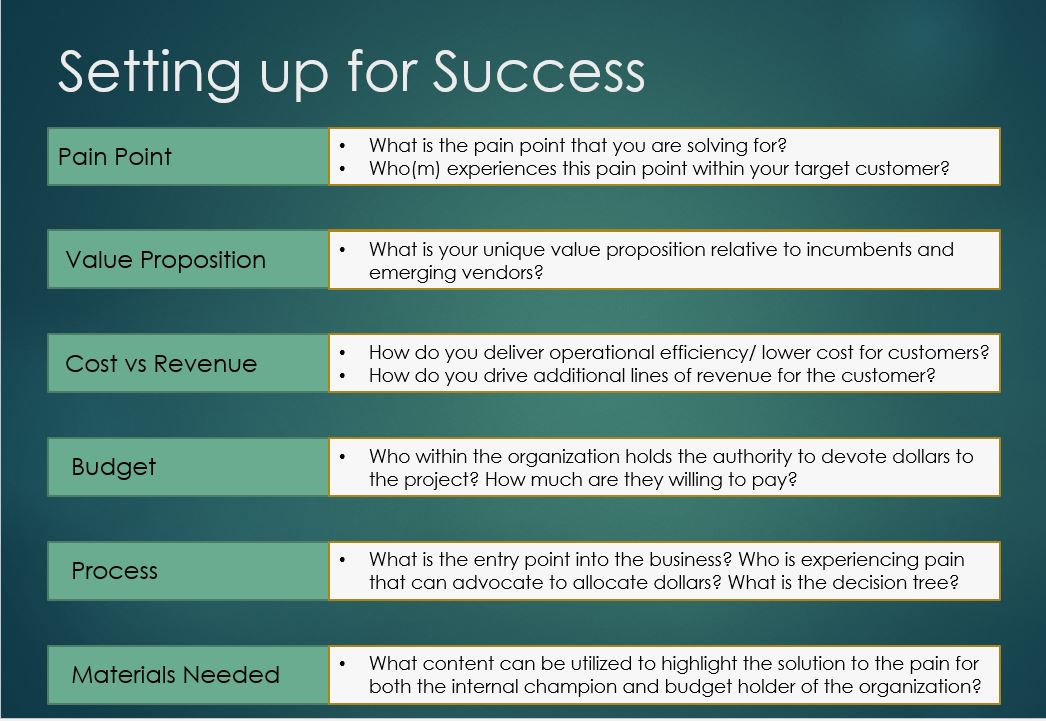
As part of the first kickoff sales meeting with our portfolio companies, I utilize a framework* that simply helps to focus on value proposition to drive early sales pitches and product focus. For example, Catalyze, one of our portfolio companies, had 3 products and sold into 2 different market segments (enterprises and start-ups) with several sub segments within each market segment. We used this framework to focus on the value proposition that would resonate across most customers and to help tailor the pitch to each segment depending upon their specific product needs. This simple framework has been an easy way to revisit and crystalize messaging based on the feedback that we’ve seen from current customers:

Travis Good, CEO of Catalyze.IO: “One of the major challenges we faced in scaling our revenue was to solidify the relevant aspects of our value to customers and distill those aspects down into something that was documented, measurable, iterative, and ultimately repeatable. Initially we documented everything in the framework on a whiteboard. We did this for each customer segment that we had. We then transferred this into a shared Google Doc and collaborated over time based on discussions with customers and prospects.

It was immensely valuable for us to take the time to systematically assess our products and market using the framework provided. The process, as well as the outcome of the process, has evolved but continues to be of use for us as we transition from stage, to Series A, and to preparing for Series B. Despite initiating this process early on, post our seed funding, I do feel that thinking through this framework earlier on would have been beneficial to use in testing some of our early hypotheses and accelerate our path to product market fit.”

Setting up for success

Pain Point

  • Typically experienced by founder/management team from previous personal experience
  • Is the problem difficult to solve with existing solutions or human capital in a cost effective manner? Does the customer know they have pain? How badly do they want to fix it?
  • Methodically assess both qualitative and quantitative size and urgency of pain point

 Value Proposition

  • Develop one line pitch to describe 1) who the product helps, 2) how it solves the problem, and 3) how it is unique
  • You have a solution to a customer’s problem, so what? Why should they buy your product?

 Cost vs Revenue

  • How does the product help customers to reduce spend across product development, time to market, human capital, or operational efficiency?
  • How does the product help customers to create additional revenue by enhancing their existing product investments, differentiating from competition, or changing the delivery mechanism of their service/offering?

 Budget/ Process

  • Every sale is different but there are typically multiple players involved in an enterprise sales decision, who holds budget and who is the internal champion?
  • What are the needs/goals of each player along the decision chain and how do you create messaging to address each?
  • Map process and appropriate steps to involve the proper resources and employ corresponding messaging at each stage of the sales process

 Content

  • Create case studies, white papers, ROI calculators, customer interviews, and sales stage specific content to drive customers through each stage of the sales process
  • Reward initial customers for taking the risk on a start-up, make them heroes, sing their praises

 Competition

  • Map out competitors across product areas/verticals
  • How does your company compete from a product, process, messaging standpoint?
  • How do you prove it with content/customer references?
  • What is your unfair competitive advantage and how do you defend it?

 This exercise is meant to provide clarity as founders too often get lost in the weeds and fail to deliver a simple message that resonates with prospective customers, why did our customers buy in the first place and how do they get value out of your product?

Happy hunting and we’ll dive deeper into “pain point” in my next post. I’d love to hear what thoughts, comments, and questions pop up as you try this exercise. Please feel free to comment below or DM me on Twitter at @Jduboe

* that is a somewhat simplified version of the methodology  employed by David Skok (who produces phenomenal SaaS related content) and Mark Cranney (a16z operating partner).